


Introduction
The Muscle Problem You Need to Know About
The muscle problem you need to know about is not simply about losing weight. It is about what happens inside your body while the number on the scale goes down. At first, weight loss seems straightforward. You step on the scale. The number drops. You feel excited. However, the scale does not tell the whole story.
What exactly are you losing?
When your body loses weight, it does not lose only body fat. Instead, weight loss can involve water, glycogen, and lean tissue. Therefore, two people can lose the same amount of weight while experiencing very different changes in their bodies.
This question has become increasingly important with the growing use of GLP-1-based weight-loss medications. Medications such as semaglutide, liraglutide, and tirzepatide can help appropriate patients achieve significant weight loss. However, researchers are also studying an important issue: what happens to lean mass during that weight loss?
That brings us to the question many people are now asking:
Does GLP-1 weight loss also mean muscle loss?
The answer is more complex than many headlines suggest. First, some studies have reported reductions in lean mass during GLP-1-associated weight loss. However, lean mass is not the same as skeletal muscle. Therefore, we should not assume that every pound of lost lean mass represents a pound of lost muscle. In addition, some lean-mass loss can occur during weight loss regardless of how the weight loss happens.
So, the real question is not simply:“Do GLP-1 drugs cause muscle loss?”
Instead, we should ask:
“How can you lose excess fat while protecting your muscle, strength, and physical function?”
That is the muscle problem you need to know about. And more importantly, it is a problem you can approach with a smarter strategy.
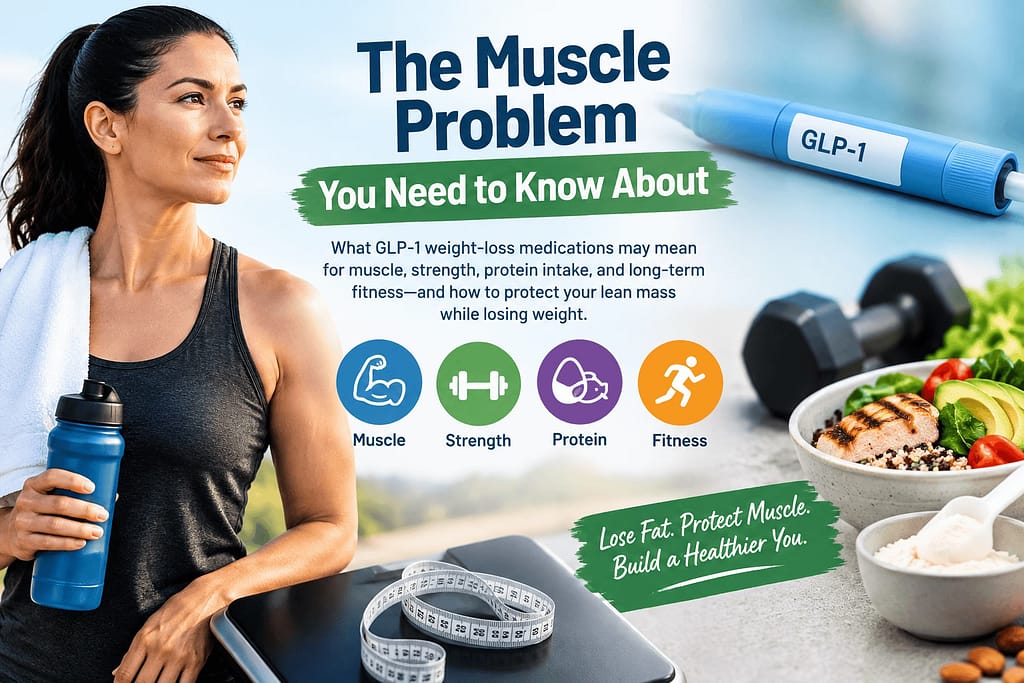
What GLP-1 weight-loss medications may mean for muscle, strength, protein intake, and long-term fitness—and how to protect your lean mass while losing weight.
What if the number on your bathroom scale isn’t telling the whole story? At first, weight loss seems simple. You step on the scale. The number goes down. You feel encouraged. However, there is a bigger question.
What exactly are you losing-The Muscle Problem You Need to Know About
When you lose weight, your body does not lose only fat. Instead, weight loss can also involve water, glycogen, and lean tissue. Therefore, the scale cannot tell you everything. This issue has become especially important with GLP-1 weight-loss medications. These medications can help many people lose significant amounts of weight. However, researchers are also studying what happens to lean mass during that weight loss.
That brings us to an important question:
Does GLP-1 weight loss also mean muscle loss?
The answer is more complicated than many headlines suggest.
First, some studies have found reductions in lean mass during GLP-1-based weight loss. However, lean mass is not the same thing as skeletal muscle. Therefore, we should not automatically assume that every pound of lost lean mass represents a pound of lost muscle. In addition, weight loss itself can reduce lean mass. This can happen with dieting and lifestyle-based weight loss too.
A 2026 systematic review and meta-analysis found that lean mass represented roughly 25% to 39% of total weight lost across several incretin-based treatments. However, similar patterns appeared with lifestyle interventions. Moreover, a lifestyle intervention combined with resistance training showed a more favorable lean-mass pattern.
So, the real question is not simply: “Do GLP-1 drugs cause muscle loss?”
Instead, we should ask:
“How can you lose excess fat while protecting your muscle, strength, and physical function?” That is the muscle problem you need to know about.
What Are GLP-1 Weight-Loss Drugs-The Muscle Problem You Need to Know About
First, let’s understand what GLP-1 means. GLP-1 stands for glucagon-like peptide-1. It is a hormone that plays several roles in the body. For example, it helps regulate appetite and blood glucose. It also affects digestion. GLP-1 receptor agonists mimic some of these natural effects. Some newer medications also target another pathway called GIP.
Examples include:
- Semaglutide
- Liraglutide
- Tirzepatide
These medications can reduce appetite. They can also increase feelings of fullness. As a result, many people consume fewer calories. Over time, that can produce substantial weight loss. However, there is an important distinction.
Weight loss is not the same as fat loss.
Your body contains several types of tissue. Therefore, when your body weight falls, different components can change.
These include:
- Body fat
- Skeletal muscle
- Water
- Glycogen
- Other lean tissues
Consequently, a lower scale number does not tell the complete story.
The Muscle Problem: What Actually Happens During Weight Loss?
Now we can get to the heart of the issue. When you lose significant weight, some lean mass may also decline. Importantly, this does not happen only with GLP-1 medications. It can happen with many forms of weight loss. For example, a person who follows a calorie-restricted diet may lose both fat and lean tissue. Likewise, someone who loses weight through medication may experience changes in lean mass. However, the amount can vary considerably.
A 2026 meta-analysis examined 20 randomized controlled trials involving more than 15,000 participants. The researchers found that lean mass represented approximately 25% to 39% of total weight loss across several incretin-based treatments. However, the proportion was broadly comparable with lifestyle interventions. Therefore, we need to avoid one common mistake.
Lean Mass Does Not Equal Muscle Mass-The Muscle Problem You Need to Know About
This point is extremely important. Researchers often use tools such as DXA to measure body composition. However, DXA-derived lean mass includes more than skeletal muscle. It can include water and other non-fat tissues.
Therefore, a reduction in lean mass does not automatically equal the same amount of muscle loss. Furthermore, it does not automatically mean that someone has developed sarcopenia. Recent research emphasizes this distinction. Researchers have noted that reductions in measured lean mass should not automatically be interpreted as clinically significant muscle loss. So, we need to look beyond the scale. We also need to look beyond one body-composition measurement. Instead, we should consider strength, physical function, muscle quality, nutrition, and overall health.
Does GLP-1 Actually Cause Muscle Loss?
The short answer is, some lean mass can decline during GLP-1-associated weight loss. However, current evidence does not show that GLP-1 medications inevitably cause dangerous muscle loss.
That distinction matters. First, several studies have reported reductions in lean mass. However, researchers have also found that lean-mass changes can occur during lifestyle weight loss. Therefore, GLP-1 medication is not necessarily the unique cause. In addition, the percentage of lean mass lost can vary between studies and individuals.
A 2026 meta-analysis found that lean mass accounted for approximately 25% to 39% of weight lost across semaglutide, tirzepatide, and liraglutide studies. The researchers also found broadly similar proportions with lifestyle interventions. Another 2026 analysis found an overall reduction in lean body mass during GLP-1 receptor agonist treatment.
However, the researchers described the findings as broadly consistent with what can happen during weight loss generally. At the same time, other research has reported greater reductions in lean body mass compared with control groups in some trials. Therefore, the evidence remains mixed. More importantly, researchers still need better long-term studies. They need studies that measure actual skeletal muscle. They also need to measure strength. Finally, they need to measure physical performance. That is because muscle quantity alone does not tell the whole story.
Why Does Losing Muscle Matter?
Muscle is much more than something you see in the mirror. Instead, muscle helps you live your daily life.
For example, your muscles help you:
- Walk
- Climb stairs
- Carry groceries
- Lift objects
- Get out of a chair
- Maintain balance
- Exercise
- Stay independent
In addition, muscle plays an important role in glucose metabolism. It also supports physical resilience. Therefore, preserving muscle becomes increasingly important as we age. Imagine two people. Both lose 30 pounds. However, their outcomes may differ.
The first person loses mostly excess body fat. They also maintain strength and physical activity. The second person loses weight but becomes weaker. They also reduce their activity and eat very little protein. Both people may see the same number on the scale. Nevertheless, their health outcomes may differ.
That is why quality of weight loss matters. The goal should not simply be a smaller body. Instead, the goal should be less excess fat while maintaining strength, muscle, physical function, and nutritional health.
Who Should Pay Particular Attention to Muscle Preservation?
Everyone who loses significant weight should think about muscle preservation. However, some people may need extra attention.
Older adults
First, older adults already face age-related changes in muscle mass and strength. Therefore, preserving muscle becomes especially important during intentional weight loss.
People with low muscle mass or strength
Similarly, people who begin a weight-loss program with low muscle reserves may have less room for additional losses.
People with sarcopenic obesity
Sarcopenic obesity involves excess body fat together with low muscle quantity or function. Therefore, simply losing weight may not solve every health concern.
People who eat very little
GLP-1 medications can reduce appetite. That can be helpful for weight management. However, very low appetite can sometimes make adequate nutrition more difficult. As a result, some people may struggle to consume enough protein and other nutrients.
People who avoid resistance training
Finally, people who do not perform resistance exercise may have less stimulus for maintaining muscle during weight loss.
Recent reviews highlight older adults and people with conditions such as sarcopenic obesity as groups that may need particular attention to muscle preservation during GLP-1-based weight loss.
Stop Looking Only at the Scale
Here is an important mindset shift.
Don’t ask only, “How much weight have I lost?”
Instead, ask:
“What kind of weight have I lost?”
Then ask another question:
“What can my body do now?”
Your bathroom scale cannot answer these questions. Therefore, consider tracking several things.
Waist circumference-The Muscle Problem You Need to Know About
First, measure your waist periodically. A shrinking waist can provide useful information about changes in abdominal fat.
Strength

First, pay attention to strength.
Secondly, can you lift the same amount?
Thirdly, can you carry your groceries?
Lastly, can you perform your normal exercises?
Physical performanceThe Muscle Problem You Need to Know About
First of all, consider daily function.
Secondly, can you climb stairs comfortably?
Thirdly, can you rise from a chair without difficulty?
Fourthly, Can you walk as well as before?
Exercise capacity
Monitor your workouts.
Answer these questions:
First: Are you maintaining your performance?
Second: Are you becoming progressively weaker?
Nutrition
Examine your diet. Ask yourself:
First: Am I eating enough protein?
Second: Am I getting enough fruits and vegetables?
Third: Am I consuming a variety of nutrient-rich foods?
Researchers increasingly recommend looking beyond body weight. They also emphasize muscle quantity, muscle quality, strength, physical performance, nutrition, and bone health.
Protein: Your Muscle’s Building Material
Now let’s talk about protein.
Protein provides amino acids. Your body uses those amino acids to build and maintain tissues. That includes muscle. Therefore, protein deserves attention during weight loss. This becomes especially important when calorie intake decreases. However, GLP-1 medications create an interesting challenge. They can reduce hunger. That can make it easier to eat less. Nevertheless, eating less can also make it harder to consume enough protein. Imagine someone who used to eat three large meals. After starting treatment, they may feel full after much smaller portions. Consequently, their total protein intake may fall. That can create a nutritional challenge.
Recent reviews suggest that approximately 1.2–1.6 grams of protein per kilogram of body weight per day may work for many adults during intentional weight loss. However, individual needs vary.
For example, your ideal intake may depend on:
- Age
- Body size
- Activity level
- Resistance training
- Health conditions
- Overall diet
- Weight-loss goals
Therefore, don’t treat one number as a universal prescription. Instead, focus on the bigger principle.
Make protein-rich foods a regular part of your meals-The Muscle Problem You Need to Know About
Good choices can include:
- Eggs
- Fish
- Poultry
- Greek yogurt
- Cottage cheese
- Beans
- Lentils
- Tofu
- Tempeh
- Soy foods
- Lean meats
If you have kidney disease or another condition that affects protein needs, talk with your healthcare professional before increasing your intake.
Strength Training May Be the Missing Piece
Protein matters. However, protein alone cannot provide the complete solution. Your muscles also need a reason to stay. That is where resistance training comes in. Resistance training challenges your muscles. As a result, it provides a signal that supports muscle maintenance and strength. You don’t necessarily need an expensive gym.
Instead, you can use:
- Dumbbells
- Resistance bands
- Weight machines
- Barbells
- Body-weight exercises
- Other resistance-training equipment
Start gradually. Then, increase the challenge over time as your strength improves.
A 2026 meta-analysis found that lifestyle intervention combined with resistance training produced a more favorable lean-mass pattern than the other intervention groups studied. Therefore, resistance training deserves a place in a muscle-preservation strategy.
The principle is simple:
Lose excess fat while giving your muscles a reason to stay.
Cardio Still Matters-The Muscle Problem You Need to Know About
Don’t misunderstand the message. Resistance training matters. However, that does not mean you should abandon aerobic exercise. Walking, cycling, swimming, jogging, and other aerobic activities can support cardiovascular health and fitness. Therefore, you do not have to choose between cardio and strength training. Instead, combine them when appropriate. Think of it this way: Aerobic exercise supports cardiovascular fitness. Resistance training supports muscle and strength. Adequate protein supports muscle maintenance. Good sleep supports recovery. Together, these habits create a more complete approach.
A Simple Muscle-Preservation Strategy
So, what should you actually do? Start with four basic principles.
1. Prioritize protein
First, include a protein-rich food in your meals. Don’t wait until the end of the day to discover that your protein intake was too low. Instead, spread protein across your meals when practical.
2. Strength train consistently
Next, train your major muscle groups regularly. If you’re new to exercise, start slowly. Also, consider professional guidance if you have a medical condition or significant physical limitations.
3. Maintain overall nutrition
Third, don’t let appetite suppression become nutritional neglect.
Eating less can help create an energy deficit. However, eating too little can make it harder to meet your nutritional needs. If nausea, vomiting, early fullness, or other symptoms make eating difficult, speak with your healthcare professional.
4. Monitor function
Finally, monitor more than your weight.
Ask yourself:
- Firstly, am I maintaining my strength?
- Secondly, can I perform normal daily activities?
- Thirdly, am I exercising consistently?
- Fourthly, am I eating enough protein?
- Next, am I becoming unusually weak?
- Lastly, has my physical performance changed?
These questions provide valuable information. Your scale cannot provide that information by itself.
What About Protein Powder?
You don’t automatically need protein powder because you’re using a GLP-1 medication. Protein powder is simply a convenient option. For some people, a shake may feel easier to consume than a large meal. For others, regular foods provide enough protein. Therefore, think of protein powder as a tool, not a requirement. Whole foods can remain the foundation of a healthy diet. However, if appetite suppression makes it difficult to meet your protein needs, talk with a registered dietitian or healthcare professional. They can help you create a practical plan.
What About Creatine?
Creatine has received considerable attention in fitness and healthy-aging research. It can support muscle energy metabolism. It can also support strength and exercise performance in many populations. However, don’t treat creatine as a magic solution for GLP-1-related muscle concerns. Current reviews discuss creatine as a possible nutritional strategy. Nevertheless, GLP-1-specific evidence remains limited.
Therefore, start with the basics.
- Protein first.
- Resistance training next.
- Adequate overall nutrition throughout.
Then consider supplements when they make sense for your individual situation. If you take medication or have a medical condition, discuss supplements with your healthcare professional.
Don’t Confuse Lean-Mass Loss With Sarcopenia
Let’s return to this important distinction. Lean-mass loss is not automatically sarcopenia. Sarcopenia involves clinically meaningful changes in muscle strength, muscle quantity, and/or physical performance, depending on the diagnostic framework. Therefore, a lower DXA lean-mass measurement does not automatically mean you have sarcopenia. It also does not automatically mean that you have lost a dangerous amount of muscle. Researchers still need better studies.
They need to measure:
- Skeletal-muscle quantity
- Muscle quality
- Strength
- Physical performance
- Long-term health outcomes
A 2026 systematic review found that current evidence remains heterogeneous. It also emphasized the need for better research into muscle quantity and quality during GLP-1-based treatment.
Therefore, don’t panic over a headline. Look at the entire picture.
The Bigger Picture: Fat Loss Still Matters
At this point, one thing should be clear. This article is not an argument against GLP-1 medications. Instead, it is an argument for better weight-loss strategies. Excess weight can contribute to serious health problems. Therefore, effective treatment can provide important benefits for appropriate patients. However, successful weight management should involve more than a lower body weight.
Instead, consider several outcomes:
- How much excess fat did you lose?
- How much strength did you maintain?
- Can you move better?
- Are you eating adequately?
- Can you maintain your progress?
These questions provide a more complete picture.
Recent research increasingly supports this broader view of weight loss. Researchers are paying greater attention to muscle, strength, physical function, nutritional adequacy, and bone health. Therefore, the goal is not simply:
Lose weight.
The goal is to improve health while preserving the physical capacity you need to live well.
Questions to Ask Your Healthcare Provider
If you’re using or considering a GLP-1-based medication, talk with your healthcare provider.
For example, ask:
- How quickly should I expect to lose weight?
- How can I protect my muscle?
- How much protein is appropriate for me?
- Should I start resistance training?
- Should I monitor my body composition?
- Are my symptoms affecting my nutritional intake?
- Would a registered dietitian help me?
- How should I adjust my exercise as my weight changes?
Your healthcare team can personalize the answers. That matters because everyone’s health situation is different.
Frequently Asked Questions
Does GLP-1 cause muscle loss?
GLP-1-based weight loss can involve reductions in lean mass. However, lean mass includes more than skeletal muscle. Therefore, a reduction in lean mass does not automatically mean an equivalent amount of muscle loss.
Does semaglutide cause muscle loss?
Studies of semaglutide have reported reductions in lean mass during weight loss. However, researchers caution against interpreting every reduction in lean mass as direct skeletal-muscle loss.
Does tirzepatide cause muscle loss?
Tirzepatide-associated weight loss can include reductions in lean mass. However, lean mass generally represents only part of total weight loss. In addition, measured lean mass does not equal skeletal muscle.
How can I prevent muscle loss while taking GLP-1?
First, consume adequate protein. Next, perform resistance training. Also, maintain adequate nutrition. Finally, monitor your strength and physical function.
How much protein should I eat while taking GLP-1?
There is no universal target. However, recent reviews suggest that approximately 1.2–1.6 grams per kilogram per day may suit many adults during intentional weight loss. Individual needs can differ.
Is resistance training important while taking GLP-1?
Yes. Resistance training provides a muscle-building and muscle-maintaining stimulus. Moreover, recent evidence supports combining resistance training with appropriate nutrition during weight loss.
Is lean mass the same as muscle mass? No.
Lean mass includes skeletal muscle, but it can also include water and other non-fat tissues. Therefore, lean-mass measurements should not automatically be treated as direct measurements of skeletal muscle.
Can you build muscle while taking GLP-1?
It may be possible. However, results depend on factors such as training experience, protein intake, energy intake, age, and health status. Therefore, don’t assume that the medication itself builds muscle. Resistance training remains central.
Should people over 50 worry more about muscle loss?
Adults over 50 should pay close attention to strength and physical function. After all, maintaining muscle becomes increasingly important for healthy aging. However, age alone does not mean that GLP-1 treatment will cause clinically significant muscle loss.
Do I need protein powder while taking GLP-1?
Not necessarily. Protein powder can provide convenience. However, many people can meet their protein needs through regular foods. Therefore, use supplements when they solve a real nutritional problem.
The Bottom Line
The scale tells only part of the story. GLP-1 medications can help appropriate patients achieve significant weight loss. However, weight loss involves more than a changing number. Some lean mass can decline during significant weight loss. Nevertheless, that does not automatically mean that GLP-1 medications destroy muscle. The science is more nuanced.
Therefore, take a smarter approach:
- Prioritize protein.
- Strength train regularly.
- Stay physically active.
- Maintain adequate nutrition.
- Monitor your strength and physical function.
Most importantly, remember this:
- First of all, did lose excess fat
- Secondly, did l Protect your muscle.
- Thirdly, did l Build your strength
- Lastly, did l Improve your health
That is a better goal than simply chasing a smaller number on the scale. And ultimately, healthy weight loss should not only help you weigh less. It should help you live better.
Want More Science-Backed Health & Fitness Advice?
Follow Kwamzworld Health & Fitness Hub for practical nutrition, exercise, weight-management, and healthy-aging advice.
Smarter Health. Stronger Bodies. Better Lives.
Medical note: This article is for educational purposes only. It does not replace individualized medical advice. If you use or are considering GLP-1-based medication, discuss your treatment, nutrition, exercise, and any concerning symptoms with your healthcare professional.


