


Introduction
Boost VO2 Max: The Longevity Hack You Didn’t Know About. Most people obsess over muscle size and scale weight. Neither predicts how long you’ll live. Your VO2 max, however, does. Here’s the best part: you can improve it in just minutes a day. Science says it might be the single best investment you’ll ever make in your future.
But what exactly is this mysterious metric? And why do longevity experts call it the ultimate biomarker? Let’s break it down step by step.
What Is VO2 Max, Really?
Think of your body as a car engine. VO2 max measures how much oxygen your engine can burn during intense effort. The more oxygen you use, the more fuel you produce. That means better endurance, sharper thinking, and a stronger heart.
Technically, VO2 max stands for “maximal oxygen uptake.” It tracks the volume of oxygen your body consumes per kilogram of body weight per minute. Elite endurance athletes often score above 70 mL/kg/min. Average adults hover around 35 to 45. The good news? You don’t need Tour de France numbers to reap massive benefits.
VO2 Max Is a Direct Predictor of Lifespan
Multiple studies confirm this bold claim. A landmark 2018 analysis in JAMA Network Open of over 122,000 adults found that people with the lowest fitness levels had up to five times the mortality risk of the fittest group—a gap larger than the difference smoking or high blood pressure made in the same population.
Even more striking, research published in Medicine & Science in Sports & Exercise showed that individuals in the highest sex-specific quartile of measured VO2 max experienced a 66% lower risk of death relative to those in the lowest quartile, after adjustment for age, race, sex, and education.
The UK Biobank study, one of the world’s largest fitness studies, found that each 1-metabolic equivalent (MET) increase in CRF lowered all-cause mortality risk by 8% and cardiovascular mortality by 9%. And a 2025 undergraduate review summarizes that across decades of research, higher VO2 max has been “consistently linked to reduced all-cause mortality, lower incidence of cardiovascular and metabolic diseases, and improved cognitive outcomes in older age”.
Conversely, a low VO2 max is more dangerous than smoking, diabetes, or high blood pressure. That’s not hyperbole—it’s peer-reviewed science. So, tracking your aerobic capacity isn’t just for marathoners. It’s for anyone who wants to see their grandchildren graduate.
Why VO2 Max Matters More Than Your BMI
Body mass index has dominated health conversations for decades. Yet, BMI is a flawed tool. It doesn’t distinguish fat from muscle. It ignores where you carry weight. Worst of all, it tells you nothing about your cardiovascular engine.
Cardiorespiratory Fitness Outweighs Body Fat-VO2 Max (Maximal Oxygen Uptake)
Recent research flips the script. A 2026 study published in the Journal of the American College of Cardiology (JACC) followed over 24,500 adults. The result? Higher midlife fitness is strongly associated with later onset of chronic disease, lower overall disease burden, and longer life expectancy.
The findings are remarkable. Compared with low-fit participants, those with high fitness in midlife:
- Developed chronic diseases at least 1.5 years later
- Had 9%–12% fewer major diseases after age 65
- Lived 2%–3% longer overall
Importantly, the study emphasizes health span—not just lifespan. Fitness helps people live more of their lives in good health, not simply live longer with disease. These patterns held across different ages, body weights, and smoking histories. Therefore, focusing solely on weight loss misses the bigger picture.
Active Aging Fitness Depends on Oxygen Efficiency
As we age, VO2 max naturally declines about 1% per year after age 30. This decline accelerates after 60. Consequently, everyday tasks become harder. Climbing stairs feels breathless. Playing with kids leaves you exhausted.
But here’s the empowering truth: you can slow, halt, or even reverse that decline. A multi-marathoner study published in Scientific Reports found that this distinct endurance cohort maintains “exceptional cardiorespiratory fitness across the lifespan, with potential implications for longevity and long-term health”. Active aging fitness isn’t about fighting gravity. It’s about feeding your cells the oxygen they crave.
The 3 Best Ways to Boost Your VO2 Max: The longevity hack
Improving your VO2 max doesn’t require fancy equipment or gym memberships. It requires consistency, intensity, and smart programming. Let’s explore three evidence-backed methods.
Zone 2 Training Builds Your Aerobic Base You Didn’t Know About
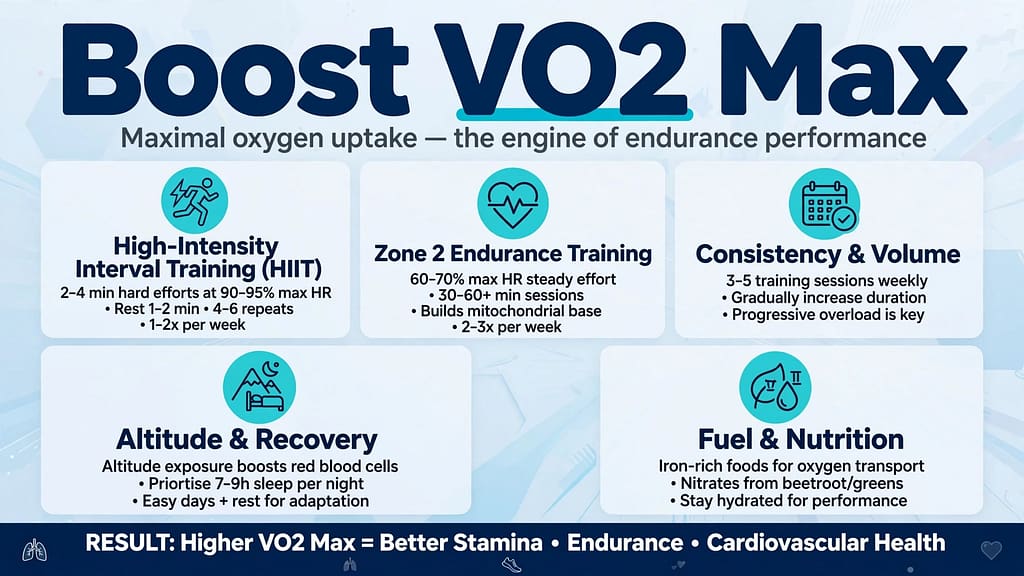
Zone 2 training is the foundation of longevity fitness. This is low-to-moderate intensity exercise where you can still hold a conversation. Think brisk walking, easy cycling, or light jogging. Your heart rate stays between 60% and 70% of maximum.
Why does this matter? Zone 2 work enhances mitochondrial density. Mitochondria are your cells’ power plants. More mitochondria mean better fat oxidation and less lactate buildup. Research indicates that a large proportion of moderate-intensity training (Zone 2) has a moderate effect on cardiac vagal activation, which is linked to better recovery and physiological performance.
Most importantly, Zone 2 is sustainable. You can do it daily without burnout. Aim for 150 to 300 minutes per week. Split it into 30- to 60-minute sessions. Your heart will thank you—quietly, consistently, and powerfully.
High-Intensity Interval Training (HIIT) Pushes Your Ceiling
Zone 2 builds the base. HIIT raises the roof. High-intensity interval training involves short bursts of all-out effort followed by recovery. Think sprints, battle ropes, or burpees done in 20-second work intervals with 40-second rests.
HIIT forces your heart to pump maximum blood volume. It stretches your stroke volume—the amount of blood ejected per beat. Over time, this increases your VO2 peak. A 2026 meta-analysis published in Physiological Reports confirmed that integrating hypoxia with HIIT provides “significant VO2 max adaptations” . Even better, HIIT improves insulin sensitivity and reduces visceral fat.
A comprehensive meta-analysis in the Journal of Human Kinetics found that moderate-intensity continuous training (MICT) showed a greater effect on VO2max compared to HIIT (MD = 2.48), suggesting both methods have their place. Similarly, an NIH meta-analysis confirmed that both sprint interval training (SIT) and HIIT significantly improve cardiorespiratory fitness compared to control groups, with HIIT showing a large effect size (SMD = 2.04).
However, HIIT is demanding. Start with one or two sessions weekly. Gradually increase intensity, not frequency. Listen to your body. Recovery is just as important as exertion.
Combine Strength Training with Cardio for Synergy
Pure cardio isn’t enough. Strength training complements aerobic work beautifully. Compound movements like squats, deadlifts, and lunges recruit large muscle groups. These muscles demand more oxygen during and after exercise.
Consequently, resistance training boosts your economy of movement. If you incorporate two-a-day workouts, you become more efficient at any given pace. Moreover, stronger muscles protect joints and reduce injury risk. That means you can train consistently without setbacks.
For best results, pair two strength sessions with three cardio sessions weekly. Alternate days when possible. This synergy accelerates your VO2 max improvements faster than either method alone.
How Fast Can You See Results?
Patience pays off—but you won’t wait forever. Most beginners notice measurable changes within 4 to 6 weeks. However, during this time, your resting heart rate drops. Next, your breathing evens out. Finally, your workouts feel noticeably easier.
Track Improvements with Simple Field Tests
You don’t need a lab coat to measure progress. The Cooper 12-Minute Run Test is a classic option. Run as far as possible in 12 minutes. Then use an online calculator to estimate your VO2 max. Repeat every month.
Alternatively, try the Rockport Walking Test. Walk one mile as fast as possible. Record your time and heart rate. Plug those numbers into a formula. Both tests are free, safe, and repeatable.
Most importantly, celebrate small wins. Did you run 50 meters farther? Did your heart rate recover 10 beats faster? Those micro-gains compound into decade-spanning benefits.
Track Your Progress Without a Lab
Modern technology puts laboratory-grade insights on your wrist. Wearable devices like smartwatches and fitness rings estimate VO2 max using heart rate and pace data. They aren’t perfectly accurate—but they’re consistently trending.
Use Wearable Tech to Monitor Active Aging Fitness
Apple Watch, Garmin, and Oura Ring all offer VO2 max estimates. These devices track your exertion during outdoor walks, runs, or hikes. Over weeks, they generate a reliable baseline. More importantly, they alert you to sudden drops, which may signal illness or overtraining.
Therefore, use wearables as directional guides. Don’t obsess over daily fluctuations. Instead, watch your 30-day average. If it climbs slowly, you’re on the right track. If it plateaus, tweak your programming.
Listen to Your Body’s Subjective Cues
Technology is helpful—but your body speaks louder. Pay attention to your perceived exertion. Use the “talk test.” During moderate exercise, you should speak in full sentences. During vigorous effort, you should gasp after a few words.
Additionally, monitor your sleep and energy levels. Poor sleep lowers your next-day performance. Chronic fatigue signals insufficient recovery. Adjust accordingly. Active aging fitness is a marathon, not a sprint.
Final Thoughts: Start Today, Reap Tomorrow
The science is irrefutable. Boosting your VO2 max is the longevity hack you didn’t know about—but now you do. It’s free. It’s accessible. And it works for every age and fitness level.
Key Scientific Takeaways:
- Low fitness = up to 5x higher mortality risk than the fittest group—a gap larger than smoking or high blood pressure
- Highest VO2 max quartile = 66% lower death risk compared to the lowest quartile
- Each 1 MET increase = 8% lower all-cause mortality and 9% lower cardiovascular mortality
- High midlife fitness = 1.5 years later chronic disease onset, 9%–12% fewer diseases, and 2%–3% longer lifespan
- HIIT and Zone 2 training both significantly improve VO2 max through different but complementary mechanisms
So, lace up your shoes. Set a 10-minute timer. Walk briskly, then jog lightly. Repeat tomorrow. In one month, retest yourself. In one year, thank yourself.
Your future self will breathe easier—literally and figuratively.
Disclaimer: This article is for informational purposes only and does not constitute medical advice. Always consult your healthcare provider before beginning any new exercise program, especially if you have pre-existing conditions or are over 40.
Scientific References
- Multi-marathoners maintain exceptional cardiorespiratory fitness across the lifespan with implications for longevity. Scientific Reports, 2026
- Midlife Cardiorespiratory Fitness and Healthy Aging: An Observational Cohort Study. JACC, 2026
- VO2max as a central biomarker of healthspan and longevity. Capstone, UNC Asheville Journal of Undergraduate Scholarship, 2025
- HIIT combined with hypoxia provides significant VO2 max adaptations. Physiological Reports, 2025
- Cardiorespiratory fitness assessment in UK Biobank: 8% lower all-cause mortality per 1-MET increase. UK Biobank, 2025
- High midlife fitness linked to longer healthspan, fewer diseases, longer lifespan. JACC, 2026
- HIIT vs. MICT effects on VO2max in endurance runners. Journal of Human Kinetics, 2026
- SIT and HIIT significantly improve CRF vs. control with large effect sizes. NIH/PMC, 2025
- VO2max and mortality: 66% lower death risk in highest quartile. Medicine & Science in Sports & Exercise, 2023
- JAMA Network Open analysis: lowest fitness = 5x mortality risk. JAMA Network Open, 2018

Post navigation
Previous Post
 Rewire Your Brain: The Secret to a Longer Life
Next Post

