


Introduction
The Hidden Health Benefits of Sunlight Most People Don’t Know. Imagine this: You wake up before sunrise. Then drive to work with the windows up. After that, you spend eight hours under fluorescent lights. Finally, you drive back home in the dark. By the time you finally look up, the day is over, and you never once felt the sun on your face.
In this article, you’ll learn about the hidden benefits of sunlight. You will also learn about how much you actually need, and how to get it safely, because too much sun carries real risks. The goal is balance, not burning. Lastly, you’ll find simple habits you can start using today, no gym membership or supplement required.
Let’s start with why your body cares about sunlight in the first place.
1. Why Sunlight Matters More Than We Think

For most of human history, sunlight wasn’t something people had to think about. It was simply the backdrop of life. Our ancestors woke with the dawn, hunted, gathered, and farmed under open skies, and settled down when darkness fell. Researchers describe how, across more than 10,000 generations of Homo sapiens, the contrast between bright daylight and nighttime darkness trained the human body clock to the Earth’s 24-hour rotation [1]. Then, in a very short span of time, everything changed. Electric lighting, office jobs, cars, and screens moved daily life indoors. Biologically, we are still outdoor creatures. Practically, most of us live like indoor ones.
How Your Body Responds to Light
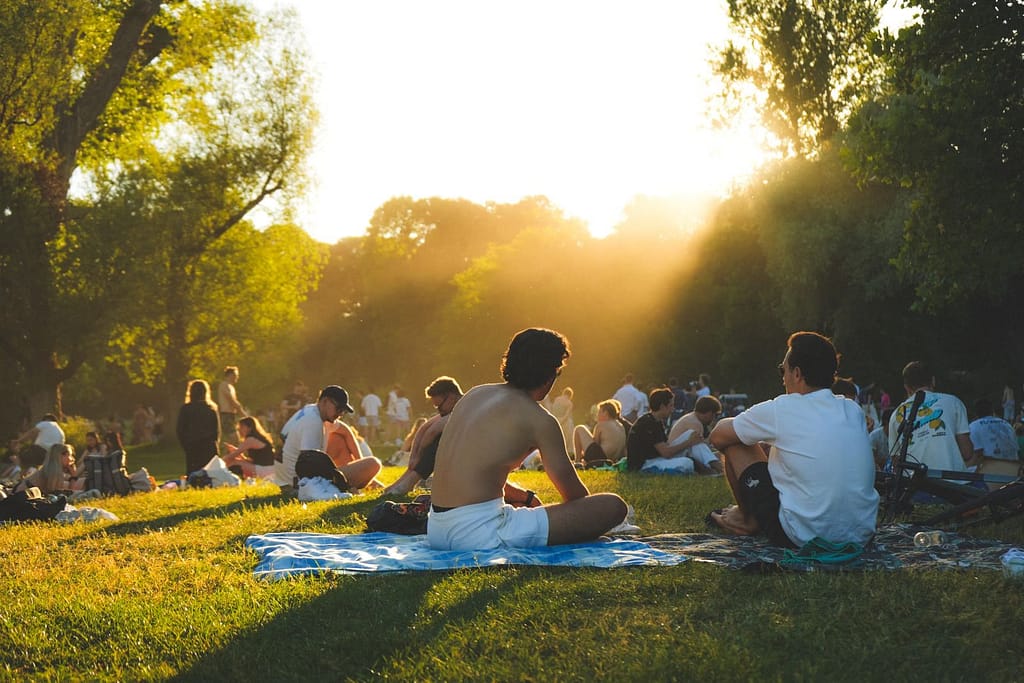
Sunlight doesn’t just make a day feel brighter. Your body treats it as information, and it picks up that information in a few different ways.
Firstly, through your skin. Ultraviolet B (UVB) rays trigger vitamin D production in the skin. Vitamin D supports bone strength, muscle function, and immune health. Sun exposure through glass does not produce it [21], which is why sitting by a window isn’t a substitute for stepping outside.
Secondly, tthrough your eyes. This is the part most people overlook. In 2002, researchers showed that a special group of retinal cells containing the pigment melanopsin sends light signals to the brain’s master clock [4]. These cells, called ipRGCs, are the main retinal input to the suprachiasmatic nucleus (SCN). This is the body’s biological clock, and they help align it with the day/night cycle [5]. You don’t need to stare at the sun. Simply being outdoors in daylight is enough.
Thirdly, through your internal clock. That master clock produces your circadian rhythm. This coordinates when you feel sleepy or alert and when hormones like melatonin rise and fall. Light is its most powerful cue. Without a clear signal, the clock can drift out of sync with the rest of your life.
The Light Gap
Light is measured in lux, and the difference between indoors and outdoors is enormous. Typical indoor lighting is around 200 lux, sunrise or sunset is around 10,000 lux, and a bright midday sky can exceed 100,000 lux [6]. Even a cloudy day is well over 1,000 lux [7], several times brighter than a typical office or living room.
Most of us don’t get much of that bright light. One study of middle-aged adults in San Diego found a median of only about 58 minutes per day above 1,000 lux [8]. At night, we have the opposite problem. Neuroscientist Charles Czeisler put it this way: we are flooding the nighttime with light while shielding ourselves from light during the day [7].
Researchers increasingly say this contrast matters. A recent international expert consensus found strong agreement that brighter light during the day supports circadian rhythms, while more light at night disrupts them and suppresses melatonin [1]. That helps explain why a body clock that gets dim days and bright nights may show up as poor sleep, low energy, and a flat mood.
None of this means indoor life is doomed. It means sunlight is a signal your body is still waiting for, and the next sections show what happens when it finally gets it.
2. Benefit #1: Better Sleep Through Your Body Clock
Most people think of sleep as something that starts when they get into bed. But when you fall asleep, and how well you stay asleep, are largely set by your body clock. That clock takes its cues from light, and it is especially responsive to light in the morning.
What Your Body Clock Does at Night
Your circadian rhythm runs on a roughly 24-hour cycle. One of its key signals is melatonin, a hormone that promotes sleep and physiologically prepares the body for nighttime [9]. Melatonin normally rises in the evening. Its timing is one of the most reliable ways scientists measure where a person’s internal clock is set [10].
Light acts as the dial. Light in the evening and at night can suppress melatonin and delay its normal timing [11]. Even ordinary household lamps count. One study found that evening exposure to conventional lamps changed melatonin levels and alertness within 30 minutes [12].
Why Morning Light Matters
The clock is not equally sensitive to light at all hours. Morning light nudges it earlier, which tends to make you sleepy earlier at night. Researchers call this a “phase advance.” In one home-based experiment, morning blue light advanced the melatonin rhythm by about 84 minutes, compared with about 48 minutes for morning amber light [11].
Real-world data points the same way. A 2025 study in BMC Public Health reports that exposure to morning sunlight, particularly before 10 a.m., is associated with earlier sleep onset and a more aligned circadian rhythm [13]. That is an association, not proof of cause, but it fits the lab evidence.
The Camping Experiment-The Hidden Health Benefits of Sunlight
The most striking evidence comes from a study at the University of Colorado Boulder. Volunteers spent a week camping in summer, with four times more light by day than usual and no headlamps or flashlights at night [9]. Afterward, the onset of their melatonin came nearly two hours earlier, near sunset [9]. This confirmed an earlier finding that an electrical-lighting environment pushes the body clock later [6].
A follow-up study showed how quickly this can happen. After only a summer weekend outdoors, campers’ melatonin rise shifted 1.4 hours earlier [9]. The researcher said this was 69 percent of the shift seen after a full week of natural light [9]. That study was small (nine campers and five people who stayed home), so treat it as a compelling clue, not the final word.
Daytime Light Also Protects Your Evenings
Bright days may help you handle evening light better. In a controlled study, late-evening light lowered melatonin and sleepiness, but daytime and early-evening exposure to bright light can mitigate some of the sleep-disruptive consequences of light exposure later in the evening [14]. That helps explain why the same lamp may bother a person who spent the day indoors more than a person who spent the day outside.
What This Means for You
- Get outside in the morning. The research points to earlier in the day, ideally before mid-morning, as the most useful time for light.
- Go outdoors, not just near a window. Indoor light is far dimmer than daylight, as the previous section showed.
- Keep evenings dim. Lower the lights in the hour or two before bed.
- Keep it consistent. Your clock responds to regular patterns, not one-off efforts.
What the Science Can’t Tell Us Yet
Researchers still don’t know exactly how much morning light is enough. A recent review notes that while morning light is known to induce phase advances, whether it can shift human melatonin rhythms within a single day is not yet well characterised [15]. People also differ widely: some individuals had suppressed melatonin under typical room light, while others did not react to moderate light [11]. Morning sun is a well-supported habit, but not a guaranteed cure for insomnia. Anyone with persistent sleep problems should talk to a doctor.
3. Benefit #2: Improved Mood and Mental Well-Being
Ask people how they feel on the first bright day after a long stretch of gray weather, and most will describe it the same way: lighter, more energetic, more hopeful. That feeling has some real biology behind it, although the science is still catching up to everyday experience.
Light and the Brain’s “Feel-Good” Chemistry
Serotonin is a chemical messenger that helps regulate mood. The strongest direct evidence linking it to sunlight comes from a study published in The Lancet. Researchers took blood samples from the veins draining the brains of 101 healthy men and found that the brain’s turnover of serotonin was lowest in winter [16]. It was also directly related to how many hours of bright sunlight there had been, and it rose rapidly with increased brightness [16]. The authors concluded that changes in the brain’s serotonin release may underlie seasonal mood changes and seasonal affective disorder [16]. It is a modest sample of healthy men measured at one point in time, so it doesn’t prove that sunlight causes better mood. But it is one of the few studies to measure this in the living human brain.
What About Ordinary Sunlight and Everyday Mood?
Here the evidence is thinner, and it’s worth being honest about that. A 2021 study on sunlight and major depression noted that many studies of the topic have methodological problems [20]. The link between sunlight and mood is plausible and biologically supported, but researchers have not pinned down how much outdoor time is needed to lift the mood of an otherwise healthy person. The idea that a short walk outside works like a reset is common, and it makes sense. Bright light, movement, and fresh air probably all contribute, but studies have not clearly separated their effects. Think of a daily dose of daylight as a low-risk habit that may support your mood, not a proven treatment.
What This Means for You
- Prioritize daylight during darker months. When days are short, a brief morning outing may matter more than in summer.
- Don’t wait for a long outing. A few minutes at a time, spread across the day, still adds up to more light than staying inside.
- Notice patterns. If your mood dips reliably each winter, mention it to a doctor. SAD is treatable.
- Don’t treat sunlight as a substitute for care. If you’re struggling with persistent low mood, professional support matters more than any daylight habit.
4. Benefit #3: Vitamin D and Your Body
Vitamin D is the best-known benefit of sunlight, and the science behind it is well established. It’s also the topic where popular claims most often run ahead of the evidence, so this section separates what is solid from what is still being studied.
How Sunlight Becomes Vitamin D
Your skin is a small vitamin factory. Vitamin D is naturally present in a few foods and available as a supplement, but it is also produced endogenously when ultraviolet rays from sunlight strike the skin [21]. Specifically, UVB radiation (wavelength roughly 290 to 320 nanometers) penetrates uncovered skin and converts a cholesterol-related compound into previtamin D3, which becomes vitamin D3 [21]. That vitamin is not active yet. It is biologically inert and must be activated in two steps, first in the liver and then mainly in the kidney [21]. One detail worth remembering: UVB does not penetrate glass, so sitting in sunshine indoors by a window does not produce vitamin D [21]. Window light can still help your body clock (see Section 2), but for vitamin D you need to go outside.
What Vitamin D Does
The best-documented job of vitamin D is helping your body absorb calcium and maintain the calcium and phosphate levels needed for normal bone mineralization [21]. Without enough of it, bones can become thin, brittle, or misshapen. Deficiency causes rickets in children and osteomalacia in adults [21]. Together with calcium, vitamin D also helps protect older adults from osteoporosis [21]. Vitamin D has other roles too, including reducing inflammation and modulating cell growth, neuromuscular and immune function, and glucose metabolism [21]. Many tissues in the body have vitamin D receptors [21].
An Honest Look at the “Extra” Benefits
This is where the story gets more complicated. The National Academies’ expert committee found the evidence inadequate or too contradictory to conclude that vitamin D affects most other health outcomes, except those related to bone health [21]. A review of nearly 250 studies by the Agency for Healthcare Research and Quality reached a similar conclusion [21]. Many observational studies link low vitamin D levels to conditions such as heart disease, depression, and diabetes, but large clinical trials of supplements have mostly not confirmed that supplements prevent or treat these problems [21]. For example:
- Heart disease: Trials show that vitamin D supplementation does not reduce cardiovascular disease risk, even for people with low vitamin D levels [21].
- Depression: Clinical trials found that supplements did not prevent or treat depressive symptoms, especially in middle-aged and older adults not taking antidepressants [21].
- Muscle function: Results of studies on strength and muscle decline have been inconsistent [21].
- Cancer: Studies to date do not indicate that vitamin D reduces cancer incidence, though adequate levels might reduce cancer mortality. More research is needed [21].
This doesn’t mean vitamin D is unimportant. Supplement trials mostly enrolled people whose levels were already adequate, and they can’t tell us what happens over a lifetime of sun exposure. It does mean readers should be wary of any article, including this one, that presents vitamin D as a cure-all.
How Common Is Low Vitamin D?
Not everyone is short on it. In a US national survey covering 2011 to 2014, most people age 1 and older had sufficient levels, but 18% were at risk of inadequacy and 5% were at risk of deficiency [21]. Sun exposure is one reason blood levels are generally higher than diet alone would predict [21]. Some groups are more likely to fall short [21]:
- Firstly, people with limited sun exposure, such as homebound individuals, people who wear long robes or head coverings, and people whose jobs keep them indoors
- Secondly, older adults, whose skin makes less vitamin D and who tend to spend more time indoors
- Thirdly, people with darker skin, since more melanin reduces the skin’s ability to make vitamin D from sunlight (though it’s unclear whether the lower levels have significant health consequences)
- Fourthly, people with conditions that limit fat absorption, or people who have had gastric bypass surgery
- Lastly, breastfed infants, who usually need supplements
Should You Get Tested?
Probably not as a routine matter. The US Preventive Services Task Force found insufficient evidence to assess the benefits and harms of screening asymptomatic adults for vitamin D deficiency, and the Endocrine Society does not recommend routine testing in healthy individuals [21]. If you have risk factors or symptoms, ask your doctor.
5. Benefit #4: Energy, Focus, and Daytime Alertness
Most of us reach for coffee when we feel foggy. But your brain also uses light as a signal for how awake it should be. When that signal is weak, as it often is in a typical indoor day, energy and focus can suffer.
Light as a Wake-Up Signal
The same light-sensing pathway that sets your body clock (Section 1) also influences how alert you feel during the day. A 2023 expert consensus in Frontiers in Photonics found broad agreement that raising daytime indoor light levels, even within the normal indoor range of 50 to 500 lux, strengthens circadian rhythms (70.5% agreement) and improves daytime alertness while reducing sleepiness (74.7%) [1]. Most experts also agreed that brighter daytime light may help sleep at night, although that finding did not reach the two-thirds consensus threshold [1].
In other words, even the modest boost of a brighter room appears to matter. Real daylight, which is many times brighter than indoor lighting, is a much stronger version of the same signal.
The Morning Cortisol Connection:The Hidden Health Benefits of Sunlight Most People Don’t Know
Cortisol is often called the “stress hormone,” but it also plays a role in getting you going each day. It typically peaks in the early morning and slowly declines through the day, and a sharp rise called the cortisol awakening response occurs about 30 to 40 minutes after waking [25].
Light influences this rhythm. A 2023 systematic review of 12 studies (337 participants) found that exposure to bright light in the late night or early morning can significantly increase cortisol secretion compared with dim light, and morning light with more blue and green wavelengths tended to raise it more than red-heavy light [25].
The picture isn’t entirely tidy. One study of artificial dawn light before waking improved subjective alertness but did not confirm the higher cortisol levels seen in earlier work, and it found no significant effect on cognitive performance [26]. So it’s reasonable to say light helps shape the body’s morning “startup” hormones, but not that a certain amount of sunlight will predictably sharpen your thinking.
What Happens at Work:The Hidden Health Benefits of Sunlight Most People Don’t Know
Some of the most practical evidence comes from offices. A study by Northwestern University and the University of Illinois compared 49 day-shift office workers, 27 in windowless workplaces and 22 in workplaces with windows [22]. The workers with more light exposure had longer sleep duration, better sleep quality, more physical activity, and better quality of life [23]. A later paper summarizing the findings reports that workers near windows slept about 46 minutes longer at night and reported better scores on a vitality scale [24].
Sleep is one of the biggest drivers of daytime energy, so this is a plausible route: daylight at work, better sleep, more energy the next day. The senior author, a Northwestern sleep specialist, summarized the emerging picture as evidence that daytime light, particularly in the morning, benefits health through its effects on mood, alertness, and metabolism [23].
Keep in mind that this was a small pilot study, and people who work near windows may differ from other workers in ways that were not measured. It shows an association, not proof of cause.
Windows Help, but Outside Is Better
A window is a good start, but it has limits. According to the study’s architect co-author, daylight from side windows almost vanishes 20 to 25 feet from the window [23]. And as Section 1 showed, indoor light is far dimmer than even a cloudy day outside [1, 6, 7]. Windows do not supply vitamin D (Section 4), though they do supply the visible light that most alertness effects depend on.
What This Means for You: The Hidden Health Benefits of Sunlight Most People Don’t Know
- Start the day with light. Morning light lines up with your body’s natural cortisol rise and clock signal.
- Move your workspace toward a window if you can, ideally within 20 to 25 feet.
- Take your breaks outside. Even a short walk gives you far more light than any office.
- Try daylight before the third coffee. It won’t replace caffeine, but it may help you need less of it. This is a practical suggestion, not a research finding.
What We Don’t Know Yet: The Hidden Health Benefits of Sunlight Most People Don’t Know
Researchers still don’t know how much light, for how long, is needed to measurably improve focus in everyday life. Lab findings on cortisol and alertness used specific lights, timings, and small groups. The office studies are observational. A fair summary is that daylight is a well-supported ingredient for alertness, not a proven focus hack.
6. Other Emerging and Lesser-Known Benefits
Sleep, mood, vitamin D, and alertness are the benefits with the most research behind them. This section covers newer and less certain territory. Some of these findings are fascinating, but they come with more caveats, and being upfront about that is what keeps a health article credible.
Blood Pressure: A Vitamin D-Independent Effect?
The most interesting emerging finding is that sunlight may lower blood pressure through a pathway that has nothing to do with vitamin D.
Your skin holds stores of nitric oxide, a molecule that relaxes blood vessels. In a study of 24 healthy volunteers, researchers irradiated the skin with UVA light and found that blood pressure dropped, alongside changes in circulating nitrate and nitrite. The authors concluded that sunlight lowers blood pressure predominantly via UVA-mediated release of nitric oxide from the skin [27]. The senior researcher described it as a vitamin D-independent mechanism [28].
Population data point the same way. In a large observational study of 342,457 patients on hemodialysis, higher environmental UV radiation was associated with lower systolic blood pressure, in addition to the effect of temperature [29]. When the American Heart Association reported on this research, the analysis covered nearly 46 million blood pressure readings, and UV exposure was associated with lower systolic pressure regardless of temperature [30].
The Immune System: A Question Mark
- Lab doses are not a walk in the park. The volunteers received two standard erythemal doses of UVA [27], and “erythemal” refers to a dose that reddens skin. That is not the same as a casual stroll.
- It’s an association in real-world data. The population studies can’t rule out other explanations for seasonal blood pressure patterns.
- The size of the effect is unknown. The UK Health Security Agency says the exact size of the effect on cardiovascular health is unknown, though early clinical trials, epidemiological, and laboratory data support the mechanism [31].
- There is a downside. Commentary on the original study noted that nitric oxide also contributes to UV-induced genetic damage and immunosuppression, so the same process might play a role in sunlight-induced skin cancer [28].
Vitamin D is involved in immune function [21], and that’s often used to argue that sunlight supports immunity. The link to disease is less clear. Multiple sclerosis, for example, is more common farther from the equator, which led to speculation that lower vitamin D in less sunny regions may play a role [21]. But the National Institutes of Health notes that clinical trial evidence is limited, that experts can’t yet conclude vitamin D can prevent MS, and that supplementation doesn’t appear to help manage the disease [21]. Sunlight’s effects on immunity are still an open research area, and UV exposure can also suppress immune responses in the skin [28].
How Strong Is the Evidence?
Here is a quick summary across the whole article:
| Benefit | Strength of evidence |
| Sets the body clock and supports sleep | Strong |
| Vitamin D production for bone health | Strong |
| Seasonal affective disorder (via light therapy) | Strong for treatment |
| Daytime alertness and energy | Moderate |
| Mood in healthy people | Moderate to limited |
| Blood pressure lowering (nitric oxide) | Emerging |
| Longevity and heart health | Observational, debated |
| Immune benefits | Unsettled |
Summary based on the sources cited in this article.
7. How Much Sunlight Do You Actually Need?
This is the question every reader asks, and the honest answer is that there is no single number. That’s because sunlight does two different jobs in your body, and each has its own “dose.”
Two Kinds of Sunlight, Two Different Doses
Light for your body clock is about visible light reaching your eyes. It doesn’t require bare skin, works on cloudy days, and supports sleep, alertness, and mood (Sections 2, 3, and 5). UV for vitamin D is about ultraviolet B rays reaching your skin. It depends heavily on where you live, the season, the time of day, and how much skin is uncovered (Section 4).Treating these as one thing is why sun advice often sounds contradictory.
The Dose for Your Body Clock
There’s no official “minutes per day” for body-clock light, so be wary of any source that claims otherwise. What experts have done is set brightness targets. A panel of sleep and circadian scientists published consensus recommendations in PLOS Biology for healthy adults. They recommend that throughout the daytime, the light reaching your eyes should meet a minimum of 250 “melanopic” lux, a measure of how strongly light affects the body clock, and that daylight should be used first to meet this target [34]. During the evening, starting at least 3 hours before bedtime, they recommend keeping it at or below 10 lux on the same scale [34].
You don’t need to measure anything. The takeaway is that daytime should be bright, ideally from daylight, and evenings should be dim. As Section 1 showed, even a cloudy day outdoors is well over 1,000 lux [7], while typical indoor lighting is around 200 lux [6]. Outside is the easiest way to meet the recommendation. The panel’s numbers describe indoor lighting for healthy adults, not exact outdoor times. A practical rule that fits the evidence is to get outdoors in the morning, get more daylight through the day, and keep evenings dim.
The Dose for Vitamin D
For vitamin D, the NIH notes that some experts suggest about 5 to 30 minutes of midday sun (10 a.m. to 4 p.m.) on the face, arms, hands, and legs without sunscreen, daily or at least twice a week, though many influencing factors make firm guidelines difficult [21]. The UV Index is a more useful guide than the clock: Cancer Council Australia says that at a UV Index of 3 or above, a few minutes outdoors on most days is enough for most people, while below 3, midday time outdoors with some skin uncovered is advised [36]. Location matters, too. One Australian statement recommended about 20 to 30 minutes in winter in the north but up to an hour in the south, with roughly 35% of the body exposed [37]. Since those figures are Australia-specific, check your local UV forecast.
What Changes the Answer
| Factor | Effect on how much you need |
| Skin tone | People with naturally very dark skin may need more sun exposure than those with fair to olive skin for the same vitamin D levels [35] |
| Skin exposed | Uncovering more skin is more effective at raising vitamin D than spending longer outdoors [35] |
| Season and latitude | Winter and higher latitudes mean weaker UV and longer times needed [21, 37] |
| Time of day | Midday has the strongest UV; mornings are best for the body clock [21, 34] |
| Cloud, shade, smog | Reduce the UV available for vitamin D [21] |
| Age | Older adults make less vitamin D from the same exposure [21] |
| Sunscreen and clothing | Reduce vitamin D synthesis, though people rarely apply enough sunscreen to block it entirely [21] |
Summary of the cited sources.
Cloudy Climates and Busy Lives
If you live somewhere gray or dark for part of the year, your body clock still benefits from daylight, since cloudy days remain much brighter than indoors [7]. But you may make little vitamin D in winter, and the NIH notes that some people need fortified foods or supplements to meet their requirements [21]. Whether you’re one of them is a question for a doctor.
For those with seasonal low mood, light therapy boxes at 3,000 to 10,000 lux are used in the morning under medical guidance [19] (see Section 3).
If you’re short on time, spread daylight through the day in small doses: a few minutes with your morning coffee, a lunchtime walk, a short break outside in the afternoon. Nothing in the evidence suggests you need one long block.
The Safety Catch-The Hidden Health Benefits of Sunlight Most People Don’t Know
All of this comes with a trade-off, which the next section covers. Cancer Council Australia recommends a combination of sun protection measures whenever the UV Index reaches 3 or above and you’ll be outdoors for more than a few minutes [36]. In practice, that means the sunlight you need for vitamin D is usually a short, incidental dose, not a sunbathing session.
8. Staying Safe: The Balance With Sun Protection
Everything so far has made the case for more light. This section keeps the picture balanced. Sunlight is a dose, and the same ultraviolet radiation that helps your skin make vitamin D also damages it. A responsible approach holds both facts at once.
The Risk Is Real
UV radiation is a carcinogen, and UV exposure is the most preventable cause of skin cancer [21]. The CDC notes that skin cancer is the most common cancer in the United States, that unprotected skin can be damaged by UV rays in as little as 15 minutes, and that damage builds up over a lifetime [40]. UV rays are present even on cloudy days, and they reflect off water, sand, and snow [40]. Over time, too much exposure can also cause cataracts and cancers of the eye [39].
One myth is worth correcting: a tan is not a sign of health. Any change in skin color after UV exposure, whether a tan or a burn, is a sign of injury, not health [39]. And all skin types can be damaged by too much UV radiation, including darker skin [35].
How to Take Your Dose Safely-The Hidden Health Benefits of Sunlight Most People Don’t Know
The goal is to get the benefits from short, incidental exposure without crossing into damage. Here is how the health agencies suggest doing it.
Keep the vitamin D dose short. As covered in Section 7, the amount needed for vitamin D is typically a few minutes on most days when the UV Index is 3 or above [36]. There’s no benefit in staying out until your skin turns pink.
Protect yourself for anything longer. For longer outdoor time, the CDC recommends seeking shade, especially during late morning through mid-afternoon, and covering up with a long-sleeved shirt and pants if shade isn’t available [38]. It also recommends a wide-brimmed hat that shades your face, head, ears, and neck, and sunglasses that block both UVA and UVB rays [38].
Use sunscreen as one layer, not the only layer. The CDC and FDA recommend a broad-spectrum sunscreen (protecting against both UVA and UVB) with an SPF of 15 or higher [38, 41]. Reapply at least every 2 hours and after swimming, sweating, or toweling off [38]. The FDA points out that no sunscreen completely blocks UV radiation and that none is waterproof, so other protection is needed too [41].
Check the UV Index. Cancer Council Australia advises using a combination of sun protection measures whenever the UV Index is 3 or above and you’ll be outdoors for more than a few minutes [36]. When it’s below 3, protection is generally not needed unless you are at high altitude, near reflective surfaces like snow, working outdoors, or outside for long periods [36].
Does Sunscreen Block Vitamin D?
This is a common worry, so it deserves a straight answer. The NIH notes that sunscreens with an SPF of 8 or more appear to block vitamin D-producing UV rays. In practice, people usually don’t apply enough sunscreen, cover all exposed skin, or reapply regularly, so their skin probably still makes some vitamin D [21]. Federal agencies advise sun protection anyway [21]. If you’re concerned about vitamin D, that is a conversation to have with a doctor, not a reason to skip sunscreen.
Getting Light Without the Burn
Sun protection and body-clock light don’t conflict. Light for your circadian rhythm enters through your eyes (Section 1), so a hat and shade don’t stop it. Dark sunglasses do reduce how much light reaches your eyes, though research on how much that matters for the body clock is limited. A reasonable approach is to spend the first few minutes of morning light outside without sunglasses when the sun is low, and to protect your eyes and skin as the day gets brighter. This is a practical suggestion rather than a research finding. Never stare directly at the sun.
Who Needs Extra Caution-The Hidden Health Benefits of Sunlight Most People Don’t Know
Some people should be more careful and should talk to a doctor before increasing their sun exposure:
- Firstly, people with a history of skin cancer, or at high risk of it. Cancer Council Australia notes that some people avoid sun exposure for this reason [36], and that a doctor may advise limiting exposure as much as possible when the UV Index is 3 or above [42].
- Secondly, people taking medications that increase sun sensitivity. The FDA warns that some medications do this [41].
- Thirdly, people with skin conditions or a family history of skin cancer. The FDA lists a personal or family history of skin cancer among the factors that call for extra care [41].
- Lastly, infants. The American Academy of Pediatrics advises keeping infants younger than 6 months out of direct sunlight [21].
If you can’t safely get sun, the answer is not to go without vitamin D. Food, fortified products, and supplements are options, and a doctor can help decide which [21, 36].
The Bottom Line
Sunlight is best treated like a nutrient with a healthy range. Too little and your sleep, mood, and bones may suffer. Too much and you risk lasting skin damage. Aim for regular, moderate, incidental exposure, protect yourself when you’ll be out longer, and adjust for your own skin and health.
9. Easy Ways to Get More Sunlight Starting Today
You now know what sunlight does and how to take it safely. This section turns that into habits. None of them needs a gym membership, a gadget, or a big change to your schedule, and each one is tied to something covered earlier in the article.
Seven Simple Habits That Pay Off
1. Step outside early. Make morning daylight your anchor habit. Research links morning sunlight, particularly before 10 a.m., with earlier sleep onset and a more aligned body clock [13]. The morning light nudges the body clock earlier [11]. Even a few minutes on a doorstep, balcony, or sidewalk counts as a start. Just don’t look directly at the sun.
2. Take your first coffee or breakfast outside. Attaching light to something you already do is the easiest way to make it stick. If you have no outdoor space, sit by an open window or doorway.
3. Walk part of your commute. Get off the bus a stop early, park farther away, or walk the last stretch. The payoff is bigger than it looks. Even a cloudy day is well over 1,000 lux [7], while typical indoor lighting is around 200 lux [6]. In one San Diego study, middle-aged adults spent a median of only about 58 minutes a day in light above 1,000 lux [8].
4. Eat lunch or take a break outside. Midday is when UV is strongest, so keep this one short and protect your skin if you’ll stay out longer (Section 8). A bright daytime also appears to blunt the disruptive effect of light later in the evening [14].
5. Move your workspace toward the light. If you work indoors, sit as close to a window as you can, ideally within 20 to 25 feet, since window daylight fades quickly beyond that [23]. Keep blinds open. Remember that glass blocks the UVB rays needed for vitamin D [21], so windows help your body clock but not your vitamin D.
6. Take calls and walking meetings outdoors. Phone calls, brainstorming, and one-on-one meetings often work just as well while walking. This turns “dead” time into daylight time without adding anything to your schedule.
7. Dim the evenings. Getting more light by day works best with darker evenings. Scientists recommend keeping light low starting at least 3 hours before bedtime [34]. Lower the lamps, switch off overhead lights, and cut back on bright screens.
A Sample Day
| When | Habit |
| Morning | Coffee or breakfast outdoors, or a short walk |
| Commute | Walk part of the way |
| Midday | Lunch or a break outside, with sun protection if you’ll be out longer |
| Afternoon | Work near a window or take a call outdoors |
| Evening | Dim the lights in the last few hours before bed |
This is an illustrative schedule, not a prescription. Adjust it to your life.
Tips for Different Situations
- Cloudy or dark climates: Go out anyway. Daylight on an overcast day is still far brighter than indoor light [7]. If your mood drops every winter, ask a doctor about light therapy, which is used under medical guidance [19].
- Very busy days: Short bursts add up. Three five-minute breaks outdoors are better than none.
- Weekends: Time outdoors can reset your clock surprisingly fast. In one study, a summer weekend of camping shifted volunteers’ melatonin rise 1.4 hours earlier [9]. You don’t need to camp, but a weekend with plenty of natural light and a consistent sleep schedule is a good reset.
- Limited mobility or shift work: Get as much daylight as you safely can, and talk to a doctor about what works for your situation. The research summarized here mostly involved healthy adults with regular schedules.
- Anyone with skin cancer risk, photosensitive medications, or infants: Follow the cautions in Section 8 before increasing sun exposure.
Start With One
Trying all seven at once is a recipe for quitting. Pick the easiest one and keep it for a week. Once it feels automatic, add another.
Conclusion
Go back to the day we started with. You wake up, then you commute. After that, you spend eight hours under artificial light. Finally, you head home as the sun goes down. The good news is that this routine doesn’t have to be permanent. A few small changes can bring daylight back into it.
Here is what we covered:
- Sleep: Light, especially in the morning, is the strongest signal for your body clock. It shapes when you feel sleepy and when you feel alert.
- Mood: Light plays a role in the brain’s mood chemistry. Bright light therapy is an established treatment for seasonal affective disorder, though the effect of everyday sunlight on healthy people is less certain.
- Vitamin D: Your skin makes it from UVB rays, and it matters for bone health. The evidence for its other benefits is far weaker than popular claims suggest.
- Energy and focus: Brighter days appear to support alertness, and office workers with more daylight tend to sleep better.
- Emerging findings: Blood pressure, heart health, and longevity are intriguing areas of research, but they remain unsettled.
- Safety: The same UV that helps your skin also damages it. The goal is a short, regular dose, with protection for anything longer.
If there is one idea to take away, it’s that sunlight is a nutrient with a healthy range. Too little may cost you sleep, energy, and mood. Too much can cost you your skin. The sweet spot is regular, moderate, incidental exposure, adjusted for your skin, your location, and your health.
And it has the rare advantage of being free. It is everywhere, and it is already rising over your head every morning. What remains is to step into it.
Try one thing this week. Pick the easiest habit from the last section: your morning coffee outside, a walk at lunch, a phone call on the sidewalk. Keep it up for seven days and notice how you feel. Then, if you like, add another.
If this article was useful, share it with someone who spends their days indoors, and subscribe for more evidence-based health and fitness posts. I’d also love to hear which habit you chose and how it went.
This article is for general information and is not medical advice. If you have a skin condition, a history of skin cancer, take medications that increase sun sensitivity, or are dealing with persistent low mood or sleep problems, please talk to a doctor.
References
- “Lights should support circadian rhythms: evidence-based scientific consensus.” Frontiers in Photonics, 2023. https://www.frontiersin.org/journals/photonics/articles/10.3389/fphot.2023.1272934/full
- (Reserved. Removed during editing; the vitamin D claims now cite reference 21.)
- (Reserved. Removed during editing; the vitamin D claims now cite reference 21.)
- Hattar, S., Liao, H.-W., Takao, M., Berson, D.M., & Yau, K.-W. “Melanopsin-Containing Retinal Ganglion Cells: Architecture, Projections, and Intrinsic Photosensitivity.” Science, 2002. https://pmc.ncbi.nlm.nih.gov/articles/PMC2885915
- Pickard, G.E., & Sollars, P.J. “Intrinsically photosensitive retinal ganglion cells.” Science China Life Sciences, 2010. https://www.sciengine.com/doi/pdf/988e51ad77694a398193178e75a5fb76
- Wright, K.P., et al. “Entrainment of the Human Circadian Clock to the Natural Light-Dark Cycle.” Current Biology, 2013. https://pmc.ncbi.nlm.nih.gov/articles/PMC4020279/
- NPR. “Bright light in the day and dark when you sleep is good for your health, study finds.” Nov. 2024. https://www.npr.org/sections/shots-health-news/2024/11/07/nx-s1-5178149/light-exposure-circadian-rhythms-sleep
- National Toxicology Program. Cancer Hazard Assessment Report on Night Shift Work and Light at Night (citing Espiritu et al.). https://www.ncbi.nlm.nih.gov/books/NBK571591/
- University of Colorado Boulder. “Can’t get to sleep? A wilderness weekend can help.” 2017. https://www.colorado.edu/today/2017/02/01/cant-get-sleep-wilderness-weekend-can-help
- “Chronotype-Dependent Changes in Sleep Habits Associated with Dim Light Melatonin Onset in the Antarctic Summer.” https://www.ncbi.nlm.nih.gov/pmc/articles/PMC7445856/
- Tähkämö, L., et al. “Systematic review of light exposure impact on human circadian rhythm.” Chronobiology International. https://www.tandfonline.com/doi/full/10.1080/07420528.2018.1527773
- “Out of the Lab and into the Bathroom: Evening Short-Term Exposure to Conventional Light Suppresses Melatonin and Increases Alertness Perception.” https://www.ncbi.nlm.nih.gov/pmc/articles/PMC3588003/
- “The role of sunlight in sleep regulation: analysis of morning, evening and late exposure.” BMC Public Health, 2025. https://link.springer.com/article/10.1186/s12889-025-24618-8
- “Early evening light mitigates sleep compromising physiological and alerting responses to subsequent late evening light.” Scientific Reports, 2019. https://www.nature.com/articles/s41598-019-52352-w
- “Can Morning Light Phase Advance Human Melatonin Rhythms in Less Than 24 h?” PubMed. https://pubmed.ncbi.nlm.nih.gov/41832758/
- Lambert, G.W., et al. “Effect of sunlight and season on serotonin turnover in the brain.” The Lancet, 2002. https://pubmed.ncbi.nlm.nih.gov/12480364/
- National Institute of Mental Health. “Seasonal Affective Disorder.” https://www.nimh.nih.gov/health/publications/seasonal-affective-disorder
- Pjrek, E., et al. “The Efficacy of Light Therapy in the Treatment of Seasonal Affective Disorder: A Meta-Analysis of Randomized Controlled Trials.” Psychotherapy and Psychosomatics, 2020. https://extension.illinois.edu/sites/default/files/light_therapy_and_sad.pdf
- Natural Medicines. “Seasonal affective disorder” (condition series), Feb. 2025. https://naturalmedicines.therapeuticresearch.com/Content/nm/Newsletters/February2025/NatMed-Condition-Series—SAD
- “Bimodal effects of sunlight on major depressive disorder.” Comprehensive Psychiatry, 2021. https://www.sciencedirect.com/science/article/pii/S0010440X21000109
- National Institutes of Health, Office of Dietary Supplements. “Vitamin D: Fact Sheet for Health Professionals.” https://ods.od.nih.gov/factsheets/VitaminD-HealthProfessional/
- Boubekri, M., et al. “Impact of windows and daylight exposure on overall health and sleep quality of office workers: a case-control pilot study.” Journal of Clinical Sleep Medicine, 2014. https://pubmed.ncbi.nlm.nih.gov/24932139/
- Northwestern University Feinberg School of Medicine. “Natural Light in the Workplace Increases Health.” 2014. https://news.feinberg.northwestern.edu/2014/08/12/zee-office-light/

Post navigation
Previous Post
 The Muscle Problem You Need to Know About