 Skip to content
Part 1: The Neuroscience of Habit—The “Habit Loop”
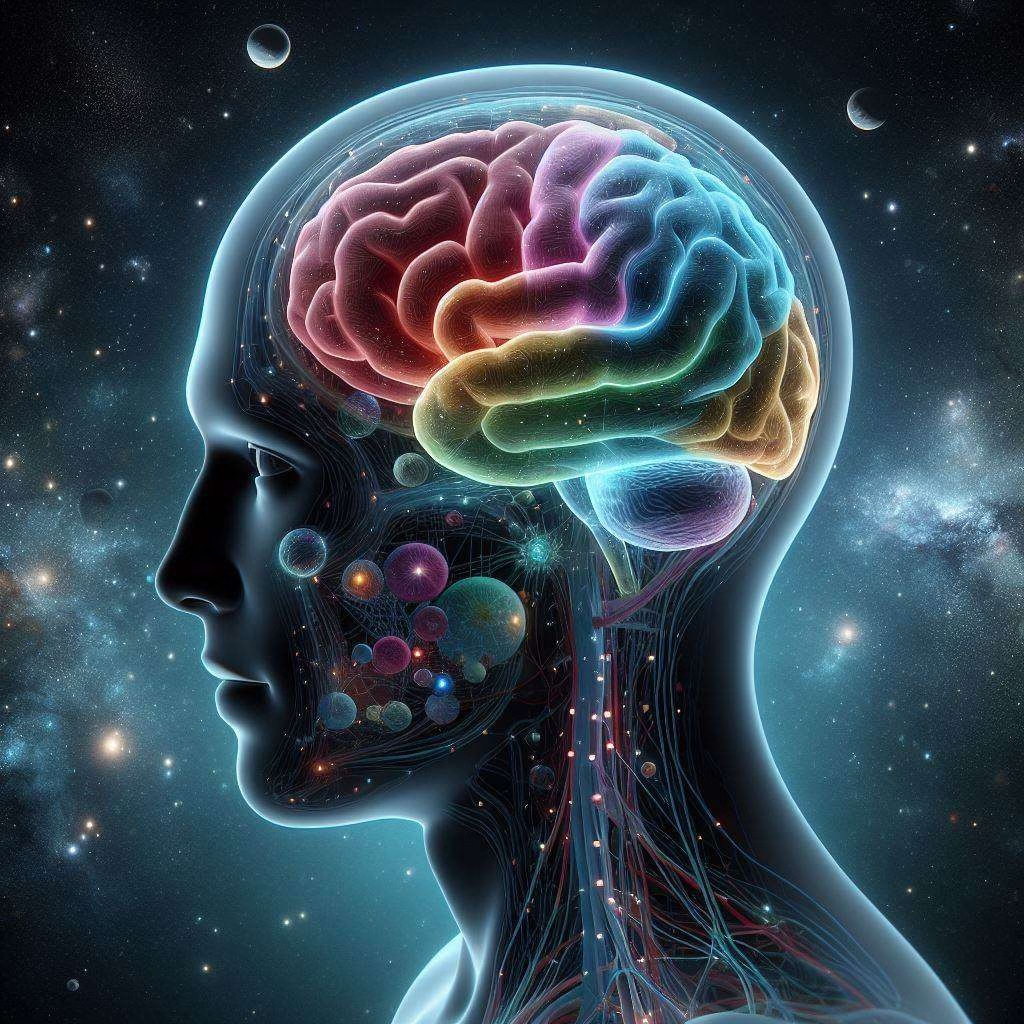
Rewire Your Brain: Break Bad Habits and Build Better Ones. Before you can change a habit, you must diagnose it. For one week, observe a habit you want to change without judgment. Note:
At the core of every habit—good or bad—is a neurological loop identified by researchers at MIT. This loop consists of four stages:
- First, The Cue: A trigger that tells your brain to go into automatic mode.
- Next, The Craving: The motivational force behind the habit (the desire for the reward).
- Then, The Response: The actual habit you perform (the thought or action).
- Finally, The Reward: The satisfying result that reinforces the loop.
Every time this loop is completed, the neural pathways involved are strengthened through a process called myelination, where a fatty sheath coats the nerve fibers, making the signal transmission faster and more efficient. Think of it as carving a deep, well-worn path in a forest. The more you walk it, the easier and more automatic the journey becomes.
This is why bad habits feel so effortless. Your brain, an efficiency machine, has simply automated a behavior to save mental energy.
Scientific Reference: The foundational model of the “habit loop” is extensively detailed in Charles Duhigg’s The Power of Habit, which synthesizes key neurological studies, including work by researchers like Ann Graybiel at MIT on basal ganglia activity in habit formation.
Part 2: The Step-by-Step Blueprint for Change- Rewire Your Brain: Break Bad Habits and Build Better Ones
To build a new path, you must first understand and then deliberately redesign the old one.
Step 1: Map Your Current Habit Loop: Rewire Your Brain: Break Bad Habits and Build Better Ones
- First, The Cue: (Time? Location? Emotional state? Other people?)
- Then, The Craving: What are you really seeking? (Stress relief? Boredom avoidance? Social connection?)
- After that, The Response: The exact action.
- Finally, The Reward: The immediate payoff. (e.g., The “donut” habit’s reward might be a 3-minute break and social interaction, not the calories).
Step 2: Disrupt and Design- Rewire Your Brain: Break Bad Habits and Build Better Ones
Now, use the rules of neuroscience to your advantage.
- To begin with, make the Cue Invisible: Remove the trigger from your environment. Unsubscribe from promotional emails, don’t keep junk food in the house, or silence phone notifications.
- After that, make the Craving Unattractive: Reframe your mindset. Instead of “I have to go to the gym,” try “I get to strengthen my body and clear my mind.”
- Next, make the Response Difficult: Increase friction for bad habits. Delete social media apps, leaving only browser access. Sleep in your gym clothes to make a morning run easier. Use commitment devices like website blockers.
- Lastly, make the Reward Immediate: Good habits often have delayed rewards. Attach an immediate, small pleasure. Enjoy a delicious post-workout smoothie or use a habit-tracking app for a satisfying “X” on the calendar. This taps into the brain’s dopamine system, reinforcing the new loop.
Step 3: Implement a “Keystone” Replacement Habit- Rewire Your Brain: Break Bad Habits and Build Better Ones
The most effective strategy is not elimination, but replacement. Identify a new, positive response to the same old cue that delivers a similar reward.
- Number one, The Old Loop: Stress at work (cue) → desire for distraction (craving) → check social media (response) → momentary escape (reward).
- Number two, The New Loop: Stress at work (cue) → desire for distraction (craving) → take three deep breaths or walk around the block (new response) → mental clarity and stress relief (reward).
Scientific Reference: Research on implementation intentions (formulated as “If X happens, then I will do Y”) has been shown to significantly increase the likelihood of habit formation. A landmark 2009 study by Phillippa Lally et al., published in the European Journal of Social Psychology, found it takes an average of 66 days for a new behavior to become automatic, highlighting the need for consistent repetition to solidify new neural pathways. Once, you have this information on your fingertips, you can decide when to put a stop to a behavior you don’t want to acquire, and then put a stop to it, before it gains a stronghold in your life.
Part 3: The Power of Repetition and Identity- Rewire Your Brain: Break Bad Habits and Build Better Ones
Understanding neuroplasticity grants you patience to shape your behavior to become a better person. Every time you perform the new behavior, you are physically weakening the old neural pathway and strengthening the new one. It’s a process of carving a new trail in the forest until it becomes the default path.
The most profound shift comes from changing your identity.
- The first is the Old Identity: “I’m someone who tries to avoid sugar.”
- The second is the New Identity: “I’m someone who eats nutritiously.”
This shift moves the habit from an external chore to an internal expression of who you are. Your behaviors naturally align with your self-image.
Scientific Reference: The role of self-perception and identity in behavior change is a cornerstone of James Clear’s Atomic Habits, which builds upon foundational psychology research, including the work of Daryl Bem on self-perception theory, which posits that individuals infer their attitudes by observing their own behavior.
FAQ: Your Habit Science Questions, Answered
Q1: How long does it REALLY take to form a new habit?
A: The myth of “21 days” is largely inaccurate. The pivotal 2009 study by Phillippa Lally and her team found that the time to form a habit varied widely, from 18 to 254 days, with an average of 66 days. Complexity matters. Drinking a daily glass of water may become automatic quickly, while a 30-minute workout will take longer. The key is consistency, not a specific deadline.
Q2: Why do I keep failing even when I know this science?A: Setbacks are not failures; they are data. They are a natural part of the neuroplastic process. The old, myelinated pathway is still there, especially under stress or fatigue. Self-criticism activates the brain’s threat centers, hindering progress. Treat a lapse as a learning opportunity: What cue did I miss? Was the new habit too difficult? Adjust your strategy and continue.
Q3: Can I ever truly “erase” a bad habit from my brain?
A: Not entirely. The neural pathway, once formed, remains. This is why former smokers can feel a craving years later under intense stress. However, with consistent practice of the new habit, the old pathway weakens from disuse, and the new pathway becomes the stronger, default option. The goal is not erasure, but dominance of the new neural pathway.
Q4: Is willpower a muscle I can strengthen?
A: The concept of “ego depletion,” which suggested willpower is a finite resource like a muscle, has faced significant scientific debate and replication challenges. Current thinking suggests that beliefs about willpower matter more. Viewing willpower as limitless can be more effective. The smarter strategy is to design your environment (make cues invisible, responses easy) so you rely less on willpower in the first place.
Conclusion: You Are the Architect of Your Brain
Firstly, breaking bad habits and building better ones is not a mystical act of self-denial. It is the practical science of neuroplasticity in action. Secondly, by understanding the habit loop, deliberately designing new responses, and patiently repeating them, you are not just changing your behavior—you are literally rewiring your brain.
First, start small. Secondly, map one habit loop. Thirdly, design one replacement. Next, celebrate tiny wins. Furthermore, remember, each repetition is a stroke of the chisel, shaping the magnificent sculpture of your future self. In addition, the power to change is built into your biology. Lastly, your job is to start the process, and best time is now!
Rewire Your Brain: Break Bad Habits and Build Better Ones
Citations & Further Reading:
- Duhigg, C. (2012). The Power of Habit: Why We Do What We Do in Life and Business. Random House.
- Lally, P., van Jaarsveld, C. H. M., Potts, H. W. W., & Wardle, J. (2009). How are habits formed: Modelling habit formation in the real world. European Journal of Social Psychology, 40(6), 998–1009.
- Clear, J. (2018). Atomic Habits: An Easy & Proven Way to Build Good Habits & Break Bad Ones. Avery.
- Graybiel, A. M. (2008). Habits, rituals, and the evaluative brain. Annual Review of Neuroscience, 31, 359–387.
