 Skip to content
✨ Introduction
Did You Know Journaling Boots Cognitive Performance? In a world overflowing with screens, notifications, and endless digital noise, a simple notebook and pen might seem outdated. But science says otherwise. Journaling is more than a reflective hobby — it is a powerful brain-training tool that improves memory, calmness, creativity, clarity, and emotional regulation.
Whether you’re trying to boost productivity, improve mental health, reduce stress, or sharpen your thinking, journaling taps into deep neural mechanisms that help your brain work better, not harder.
For more science-backed insights, explore the Kwamzworld Health & Fitness Hub.
🧠 The Neuroscience Behind Journaling and Cognitive Performance
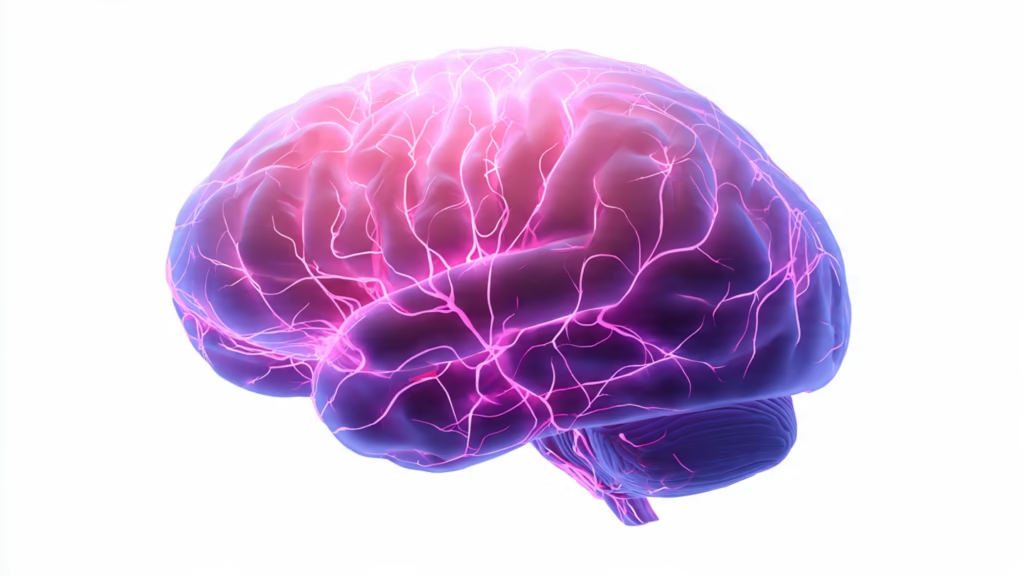
1. Handwriting Activates Multiple Brain Regions at Once

When you write by hand, you engage the motor cortex, visual centers, language networks, and memory circuits simultaneously.
This multisensory activation strengthens neural pathways responsible for:
- First, Memory encoding
- Secondly, Information processing
- Thirdly, Creativity
- Fourthly, Idea generation
- Lastly, Focus and attention
Explore more on brain health in our Mental Fitness Articles.
2. ✍️ Journaling Helps Your Brain Organize Thoughts Better

Writing forces the prefrontal cortex to structure scattered thoughts into clear language.
This improves:
- First off, Problem-solving
- Next, Decision-making
- After that, Planning
- Finally, Emotional clarity
You can also explore clarity and mindset tools in our Self-Improvement Section.
3. 😌 It Reduces Stress and Improves Emotional Regulation
Journaling activates the brain’s logic centers while reducing emotional overload.
This helps:
- Firstly, to lower stress
- Secondly, to reduce anxiety
- Thirdly, to improve self-awareness
- Lastly, to increase emotional intelligence
Find more calming practices in our Stress & Anxiety Relief Tips.
4. 🧩 It Strengthens Memory and Learning – Did You Know Journaling Boots Cognitive Performance?
Writing improves long-term memory because it requires deeper mental processing.
Your brain forms stronger connections between ideas, helping you:
- First, to remember information
- Next, to learn new skills
- Then, to understand your thoughts
- Lastly, to reflect and grow
See more science-backed learning tips on the Kwamzworld Brain & Learning Page.
5. 🌱 Boosts Creativity and Problem Solving – Did You Know Journaling Boots Cognitive Performance?

Journaling activates the brain’s default mode network — the home of imagination and insight.
This sparks:
- First, new ideas
- Next, creative breakthroughs
- Thirdly, innovative thinking
Explore creativity-boosting habits in our Mindset & Motivation Section.
❓ Frequently Asked Questions (FAQs)
1. Is journaling better than typing?
Yes. Handwriting activates more areas of the brain linked to memory, creativity, and reasoning. For more cognitive tips, visit our Mental Fitness Hub.
2. How long should I journal to see benefits?
Even 5–10 minutes daily builds clarity, mental strength, and focus.
You can explore journaling prompts in our Daily Habit Tools.
3. What should I write about?
Anything meaningful to you.
Try gratitude lists, goals, fears, ideas, or random thoughts.
Browse our Wellness & Mindfulness Guides for inspiration.
4. Does journaling help with anxiety?
Absolutely. Writing calms the amygdala and reduces emotional overload.
Read more anxiety-management strategies in our Mental Health Section.
5. Can journaling improve productivity?
Yes. Journaling clarifies priorities and helps structure your day.
See proven productivity methods in our Performance & Productivity Category.
6. What time of day is best for journaling?
Morning for focus. Evening for reflection.
For routine-building tips, visit our Healthy Lifestyle Section.
7. Do I need a special journal?
No. Any notebook works.
Check out Kwamzworld’s recommended tools on our Resources Page.
🌟Final Thoughts
Journaling isn’t just a habit—it’s a powerful cognitive workout.
With nothing but a pen and paper, you can:
- First, strengthen memory
- Also, boost creativity
- Furthermore, improve focus
- In addition, regulate emotions
- Then, increase clarity
It’s one of the simplest, most accessible ways to build a sharper and more resilient mind.
One page can change everything.✨
